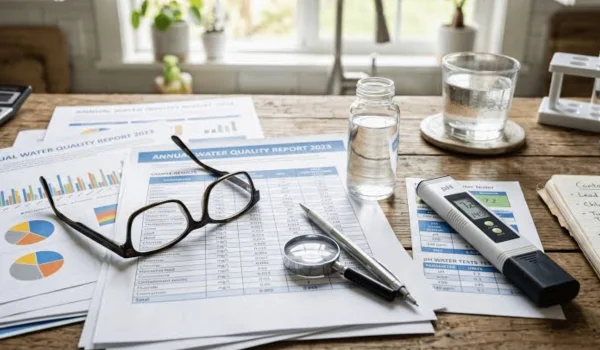
My apartment society pinned last year’s water quality report to the notice board in March. As far as I could tell, two people read it. I was one. The plumber was the other. Everyone else walked past a single page that explains why their geyser died early, why the shampoo won’t lather, and whether the tap water was ever properly disinfected in the first place. The report isn’t hard to read, honestly. You just need to know which four numbers matter. TDS, pH, hardness, chlorine. Everything else is footnotes.
TDS Demystified: How To Interpret The Number Without Being Misled By It
Total Dissolved Solids. Minerals, salts, whatever else has dissolved into the water, all lumped into one figure in mg/L (same thing as ppm, if your water quality report uses that instead). BIS calls 500 acceptable, and 2,000 permissible when there’s genuinely no better source around.
Now here’s where people get it backwards. Low is not the same as good. I’ve tasted RO water at 30 ppm and it’s weirdly flat, like drinking distilled nothing. Your body actually wants some of that dissolved calcium and magnesium. The WHO reckons water tastes best under 300 mg/L, and past 1,200 most people find it hard to drink at all. Somewhere between 150 and 350 keeps everyone happy.
The bigger problem is what TDS never measures. Bacteria don’t show up in it. Neither do pesticides. A water quality report tool with a lovely 180 ppm on the first line can still be hiding contamination further down, which is why TDS opens the conversation but shouldn’t be allowed to close it.
pH Matters Less Than You Think (And More Than Your Pipes Would Like)
Anything from 6.5 to 8.5 is fine to drink. Your stomach sits at a pH of roughly 2. It will not notice the difference between water at 6.8 and water at 7.9, I promise.
Your plumbing notices, though. Acidic water below 6.5 chews through copper and galvanised iron over the years, and that slow corrosion is precisely how metals end up in your morning glass. Push past 8.5 and the water starts depositing scale instead, plus it picks up a bitter edge. So read the pH line as a plumbing forecast, not a health score.
What Hardness And Chlorine Levels In Your Water Report Actually Mean For Your Home
Water Hardness
- Hardness measures calcium and magnesium content, expressed as mg/L of calcium carbonate.
- Below 60 mg/L is soft, 60 to 120 is moderately hard, and past 180 is very hard BIS sets the acceptable limit at 200 mg/L.
- Hard water does not threaten your health the minerals are, if anything, useful.
- What it does threaten is everything the water touches: geyser elements, kettles, your hair, and detergent efficiency, which nearly doubles with hard water.
- If your water quality report reads above 200 and you are scraping white crust off taps every month, a water softener is worth the investment.
Chlorine Levels
- Chlorine is added deliberately to prevent bacteria from surviving the journey from the treatment plant to your kitchen.
- BIS requires at least 0.2 mg/L of free residual chlorine at the point of delivery, with an upper cap of 1 mg/L.
- A faint trace of chlorine is a good sign it means disinfection held up through the pipeline.
- Near the upper limit, you get the swimming pool smell and the risk of disinfection byproducts forming where chlorine meets organic matter this is why activated carbon filters are so popular.
- If your water quality report shows zero chlorine, that is not a sign of clean water it is suspicious. Either no one disinfected the supply, or the chlorine was consumed fighting contamination in the pipes along the way.
nobody disinfected the water, or the chlorine got used up fighting something in the pipes on the way over.
Interpreting Your Water Quality Report: What The Four Key Parameters Reveal Together
One number in isolation tells you very little. Patterns talk.
| Parameter | Ideal Range | BIS Acceptable Limit | What a Bad Reading Usually Means |
| TDS | 150 to 350 mg/L | 500 mg/L | Salty or flat taste, possible groundwater intrusion |
| pH | 7.0 to 8.0 | 6.5 to 8.5 | Corroding pipes if low, scale and bitterness if high |
| Hardness | Under 120 mg/L | 200 mg/L | Dead geyser elements, double detergent, dull hair |
| Free Chlorine | 0.2 to 0.5 mg/L | 1 mg/L | Pool smell if high, failed disinfection if zero |
Take TDS of 900, hardness at 350, pH around 7.6. That’s classic untreated borewell. Or TDS of 120 with zero chlorine, which usually means an RO unit stripping the water a little too enthusiastically. One caveat worth sitting with: a water quality report is a snapshot, often a year old by the time you see it, and water changes by season and by source. If your building runs on tanker supply half the year, it’s smarter to run today’s water through a water quality checker tool than to trust last March’s numbers.
Conclusion
Pull up your latest water quality report this week. Find those four lines, pencil the numbers somewhere you’ll see them, and check again when the season flips or when the tea starts tasting off. That’s the whole system. Most household water problems in India announce themselves through these four parameters long before anyone falls ill. Reading them takes maybe five minutes. Which, come to think of it, is less time than my entire society spent walking past that notice board.