Indian businesses are increasingly serving customers across the globe. From exporters shipping products overseas to freelancers working with international clients and SaaS companies billing users worldwide, global commerce has created new opportunities for growth.
However, getting paid from abroad remains one of the biggest operational challenges. Traditional international wire transfers can be slow, expensive, and difficult to track. Hidden foreign exchange (forex) markups, intermediary bank fees, and compliance requirements can reduce the amount that ultimately reaches your account.
Fortunately, modern international payment collection solutions have made it significantly easier for Indian businesses to receive payments from overseas customers.
This guide explains the common challenges of international collections, the options available today, and best practices for receiving foreign payments efficiently.
TL;DR
- International payments often involve high fees, forex markups, and settlement delays.
- Indian exporters must comply with FEMA regulations and maintain remittance documentation.
- Modern collection solutions provide local receiving accounts in major currencies.
- Receiving payments through local banking rails can reduce costs and improve customer experience.
- Automatic INR settlement simplifies accounting and cash flow management.
- Faster settlements and easier compliance can improve working capital for exporters and service businesses.
Why Receiving International Payments Can Be Challenging
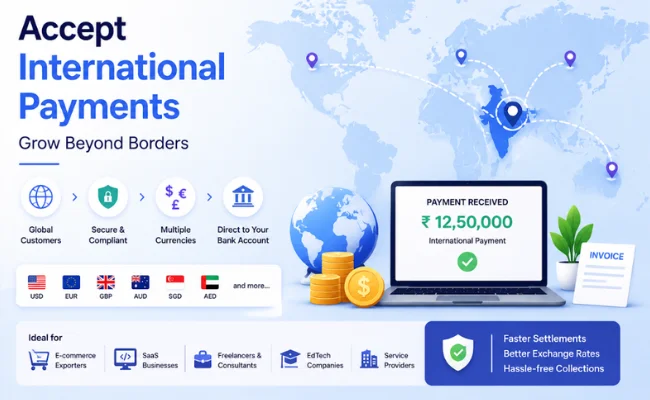
For many Indian businesses, collecting money from overseas clients is more complicated than delivering the product or service itself.
Four common challenges typically arise:
1. High Transaction Costs
Traditional international wire transfers often involve:
- Transfer fees
- Correspondent bank charges
- Receiving bank deductions
- Currency conversion costs
For smaller invoices, these costs can consume a meaningful portion of the payment.
2. Slow Settlement Times
International bank transfers frequently take several business days to complete.
Long settlement cycles can:
- Delay access to working capital
- Affect cash flow planning
- Slow vendor payments and business operations
For businesses with recurring overseas revenue, these delays can add up quickly.
3. Foreign Exchange Markups
Many businesses focus on transfer fees while overlooking exchange-rate costs.
Banks and payment providers often apply a markup above the mid-market exchange rate. Even a 2–4% forex spread can significantly impact profitability over time.
For example, on a USD 10,000 invoice, a 3% forex markup could cost approximately USD 300—often much higher than the transfer fee itself.
4. Compliance and Documentation Requirements
Indian businesses receiving foreign payments must comply with regulations under FEMA (Foreign Exchange Management Act).
This typically involves:
- Purpose code classification
- Remittance reporting
- Maintaining inward remittance documentation
- Supporting export and GST compliance requirements
Managing these requirements manually can become time-consuming as transaction volumes grow.
How Modern International Collection Solutions Work
Modern cross-border collection platforms simplify the process of receiving payments from international customers.
Instead of relying entirely on traditional wire transfers, businesses can receive funds through local banking infrastructure in major global markets.
The typical process works as follows:
- The business receives local account details in foreign currencies.
- Overseas customers make payments through familiar local banking methods.
- Funds are collected and converted into INR.
- Settlement is made to the Indian bank account.
- Compliance documentation is generated and maintained.
This approach reduces friction for both the buyer and the seller.
Key Features to Look for in an International Collection Solution
Local Receiving Accounts
Many providers offer virtual receiving accounts in major currencies such as:
- USD
- EUR
- GBP
- CAD
- AUD
These accounts allow international customers to pay using local banking methods rather than initiating expensive international wire transfers.
Benefits
- Better customer experience
- Lower payment costs
- Faster collections
- Simplified reconciliation
Local Payment Rails
Modern collection platforms often support domestic payment systems in various countries.
Examples include:
- ACH in the United States
- SEPA in Europe
- Faster Payments in the United Kingdom
Because customers pay through systems they already use, payments become easier and more cost-effective.
Automatic Currency Conversion
Holding foreign currency can create operational complexity and expose businesses to exchange-rate fluctuations.
Automatic INR settlement offers several advantages:
- Faster access to funds
- Simplified accounting
- Reduced forex management effort
- Improved cash flow visibility
For many exporters and service providers, this is the preferred approach.
Compliance Support
A strong international collection solution should simplify regulatory requirements by providing:
- Purpose code support
- Remittance documentation
- Transaction records
- Audit-ready reporting
Automated documentation reduces administrative effort and helps businesses stay compliant.
Traditional Bank Wires vs Modern Collection Solutions
| Feature | Traditional SWIFT Wire | Modern Collection Solution |
| Settlement Time | 3–5 business days | Often faster |
| Customer Experience | International transfer required | Local payment methods |
| Intermediary Fees | Common | Reduced |
| Forex Transparency | Limited | Generally more transparent |
| Reconciliation | Manual | Automated |
| Documentation | Often requires follow-up | Usually automated |
While traditional wire transfers remain useful in certain scenarios, modern collection solutions can improve efficiency for businesses receiving frequent international payments.
Who Benefits Most from Modern Collection Solutions?
Exporters
Businesses exporting goods can receive payments from overseas buyers more efficiently while improving visibility into settlement timelines and costs.
SaaS Companies
Subscription-based businesses serving global customers often benefit from faster collections and simplified currency conversion.
Agencies and Consultancies
Professional services firms working with international clients can reduce payment friction and improve cash flow predictability.
Freelancers and Independent Professionals
Freelancers often face high transfer costs relative to invoice size. Collection platforms can provide a more streamlined way to receive payments.
Online Businesses
D2C brands and digital businesses selling internationally can improve customer experience by supporting local payment methods.
Best Practices for Receiving International Payments
To maximize the value of overseas collections:
Compare Total Costs
Look beyond transfer fees and evaluate:
- Forex markup
- Banking charges
- Settlement costs
- Intermediary fees
Prioritize Faster Settlements
Shorter settlement cycles improve working capital and reduce cash flow uncertainty.
Use Transparent Forex Pricing
Understanding the exchange rate being applied can help protect margins and improve financial planning.
Keep Compliance Records Organized
Maintain accurate documentation for:
- Tax reporting
- Export compliance
- Audit requirements
- Regulatory filings
Automation can significantly reduce administrative effort.
Why Faster International Collections Matter
Efficient payment collection is not just about convenience.
Faster and more transparent international payments can help businesses:
- Improve working capital
- Reduce operational overhead
- Minimize forex-related losses
- Accelerate growth in international markets
- Spend less time managing payment administration
For growing businesses, improving collections can have a direct impact on profitability and cash flow.
Conclusion
Winning international customers is only part of the growth journey. Getting paid efficiently is equally important.
Traditional international transfers often involve settlement delays, hidden forex costs, and administrative complexity. Modern collection solutions help address these challenges by providing local receiving accounts, faster settlement, transparent currency conversion, and streamlined compliance support.
Whether you’re an exporter, SaaS company, consultant, agency, or freelancer, choosing the right international payment infrastructure can improve cash flow, reduce costs, and make global business significantly easier.
FAQs
How can Indian exporters receive international payments?
Indian exporters can receive international payments through bank wire transfers, international payment gateways, global collection accounts, and cross-border payment platforms.
What is the cheapest way to receive international payments?
The most cost-effective option depends on payment volume, currencies, and countries involved. Businesses should compare transfer fees, forex markups, and settlement costs rather than focusing on a single charge.
What is a local receiving account?
A local receiving account allows overseas customers to make payments using domestic banking systems in their own country, simplifying the collection process.
How long do international payments take to settle?
Traditional bank wires typically take three to five business days. Modern collection platforms may offer faster settlement depending on the payment method and country.
Do Indian businesses need compliance documentation for foreign payments?
Yes. Businesses receiving international payments must comply with FEMA regulations and maintain appropriate remittance documentation for regulatory and tax purposes.
How can exporters reduce forex losses?
Exporters can reduce forex-related costs by choosing providers with transparent exchange rates, comparing total costs, and using solutions that offer competitive currency conversion.