There are certain aspects of property maintenance that property owners and business managers tend to notice only when they’ve been neglected for too long. Fresh landscaping gets admired. A newly sealed parking lot gets appreciated. But pavement striping — the carefully applied lines, arrows, symbols, and markings that organize traffic flow, define parking spaces, and communicate critical safety information to everyone who uses a property — often only gets attention when it’s faded to the point of creating genuine confusion or safety hazards. For businesses and property managers across the Salt Lake Valley, working with a qualified striping company in South Jordan and surrounding areas is one of the most practically impactful and cost-effective property maintenance investments available — and understanding why requires looking closely at what pavement striping actually does and what happens when it isn’t properly maintained.
South Jordan has experienced remarkable growth over the past decade, with new commercial developments, retail centers, healthcare facilities, schools, and mixed-use properties transforming what was once a primarily residential community into one of the most economically active cities in Utah County and the greater Salt Lake metropolitan area. This growth means more parking lots, more access roads, more pedestrian pathways, and more complex traffic environments that require clear, accurate, well-maintained striping to function safely and legally.
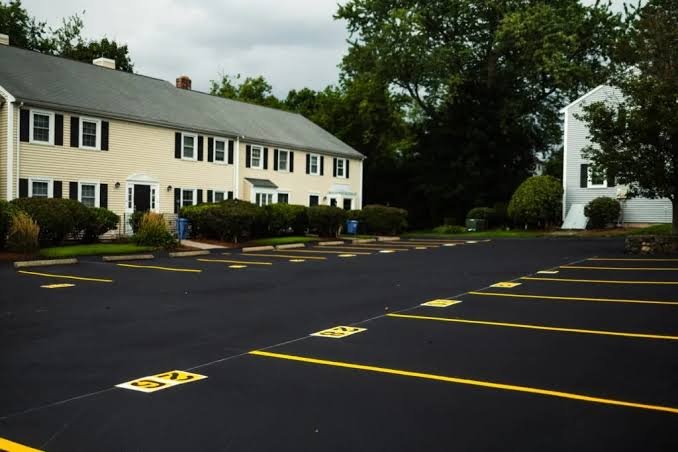
The Real Purpose Behind Pavement Markings
It’s tempting to think of parking lot striping as a purely aesthetic exercise — lines painted on asphalt to make a lot look organized. But the actual functions that pavement markings serve go well beyond appearance, touching on safety, legal compliance, accessibility, and the efficient use of valuable property.
Traffic flow management is perhaps the most fundamental function. In a busy commercial parking lot, the difference between clear directional markings and absent or faded ones is the difference between orderly, predictable traffic movement and the chaotic, accident-prone environment that develops when drivers are left to improvise their own routes through a space. Directional arrows, stop bars, crosswalk markings, and traffic lane indicators create a system that most drivers follow instinctively — but only when those markings are clearly visible and logically laid out.
Parking space optimization is another dimension of striping’s practical value that directly affects business operations. The number of vehicles a parking lot can accommodate efficiently is determined by how its spaces are laid out and marked. Improperly sized spaces, inefficient layouts, or faded lines that allow drivers to park haphazardly can reduce a lot’s effective capacity by a surprising margin — meaning that during peak periods, the property is turning customers away while spaces remain technically available. Professional striping, particularly when it incorporates updated layout thinking, can measurably increase the number of usable spaces in a given area.
Pedestrian safety is protected through crosswalk markings, designated pedestrian pathways, and the clear delineation of areas where vehicle and foot traffic intersect. In busy commercial environments, these markings play a direct role in preventing accidents — they communicate to drivers where pedestrians are expected to be and signal to pedestrians where they can cross with a reasonable expectation that vehicle traffic will yield.
ADA Compliance: The Legal Dimension of Parking Lot Striping
One of the most frequently underestimated aspects of parking lot maintenance is the legal obligation to maintain compliant accessible parking spaces under the Americans with Disabilities Act and applicable state and local building codes. This isn’t a matter of good intentions — it’s a federal legal requirement with meaningful enforcement consequences for property owners who fail to meet it.
ADA-compliant accessible parking involves more than simply having enough spaces designated for individuals with disabilities. The spaces themselves must meet specific dimensional requirements. Access aisles — the striped areas adjacent to accessible spaces that allow wheelchair users to transfer safely — must meet specific width standards. Signage must meet specific requirements. The surface of accessible spaces must be maintained in a condition that allows wheelchair access.
Over time, striping fades, surfaces deteriorate, and what was once a compliant accessible parking area may gradually become non-compliant without any single dramatic event to mark the transition. Regular professional assessment and re-striping is the most reliable way to ensure that accessible parking areas remain legally compliant as markings age.
For any business or property manager working with a striping company in South Jordan, ADA compliance should be a standard part of every striping project conversation — not an afterthought but a baseline requirement that shapes the entire parking lot layout and marking specification.
How Pavement Conditions Affect Striping Performance
The longevity and visibility of pavement striping is directly affected by the condition of the surface on which it’s applied. Understanding this relationship helps property owners plan their striping maintenance more strategically and get better long-term value from their striping investments.
Paint applied to clean, well-prepared pavement surfaces adheres more effectively and lasts longer than paint applied to dirty, oxidized, or deteriorating surfaces. This is why professional striping companies typically recommend surface preparation before application — cleaning the pavement, allowing it to dry thoroughly, and ensuring that the application surface is free of loose material, oil contamination, or previous paint that is sufficiently deteriorated to compromise adhesion of the new application.
The type of pavement markings material also affects performance longevity significantly. Standard traffic paint is the most economical option and works well in many applications, but it has shorter service life than more durable alternatives. Thermoplastic markings — applied as a heated material that bonds more deeply with the pavement surface — offer substantially longer service life and are commonly used in high-traffic areas or locations where repainting access is difficult. Epoxy-based markings offer high durability for interior applications like parking garages and warehouses. Understanding which material is appropriate for a specific application requires professional knowledge of traffic volumes, environmental exposure, and surface conditions.
Utah’s climate presents specific considerations for pavement striping performance. The freeze-thaw cycles that affect the Wasatch Front during winter months create stress on pavement surfaces and the markings applied to them. UV radiation at Utah’s elevation accelerates the oxidation of standard traffic paint. And the snowplowing that parking lots require during winter months creates mechanical wear on surface markings that can dramatically shorten their effective life in lots that experience heavy plowing activity.
When to Schedule Professional Striping Service
One of the most practical questions for property owners and managers is how frequently striping needs to be refreshed and what signs indicate that re-striping has become necessary.
Visibility is the primary indicator. When lines that were once crisp and clearly defined have faded to the point where they’re difficult to distinguish in normal daylight conditions, they’ve lost most of their functional value and should be refreshed. The test isn’t whether the lines are still technically present — it’s whether they’re clearly visible to drivers approaching and moving through the lot under normal conditions.
Seasonal timing matters for achieving good results. Late spring through early fall represents the optimal window for exterior pavement striping in Utah, when temperatures are consistently above the minimum threshold for proper paint application and curing, and when the likelihood of precipitation disrupting freshly applied markings is lower. Planning striping projects during this window and scheduling them before peak summer business periods ensures that lots look their best during the seasons of highest activity.
New pavement surfaces — whether fresh asphalt overlays or newly sealed surfaces — should be allowed to cure fully before striping is applied. Fresh asphalt typically requires 30 days of curing before striping, and newly sealed surfaces require complete curing of the sealer before paint is applied. Striping applied too early to these surfaces will adhere poorly and fail prematurely.
The Broader Impact on Business and Property Value
Clean, well-maintained pavement striping contributes to the overall impression that a property makes on the people who use it. A parking lot with fresh, clearly visible markings communicates care and professionalism that customers, tenants, and visitors register — often unconsciously — as part of their overall experience of a business or property.
This impression has tangible business value. Research on consumer behavior consistently shows that the physical environment of a business affects customer perception of the business itself — a well-maintained exterior suggests a well-managed operation. Conversely, a parking lot with faded, illegible striping, missing accessible space markings, and undefined traffic lanes suggests neglect that can subtly but genuinely affect customer confidence and satisfaction.
For property owners managing commercial real estate, well-maintained pavement striping is also a factor in tenant satisfaction and retention. Tenants whose customers and employees navigate a clean, clearly marked parking environment have fewer operational complaints to bring to property management — and that reduced friction is worth something in the long-term health of the landlord-tenant relationship.
Investing in professional pavement striping is, in the end, one of the most straightforward and cost-effective property maintenance decisions available. The safety it provides, the compliance it ensures, the operational efficiency it supports, and the professional impression it creates all deliver returns that significantly exceed the modest cost of keeping parking lot markings fresh, visible, and properly maintained throughout the year.